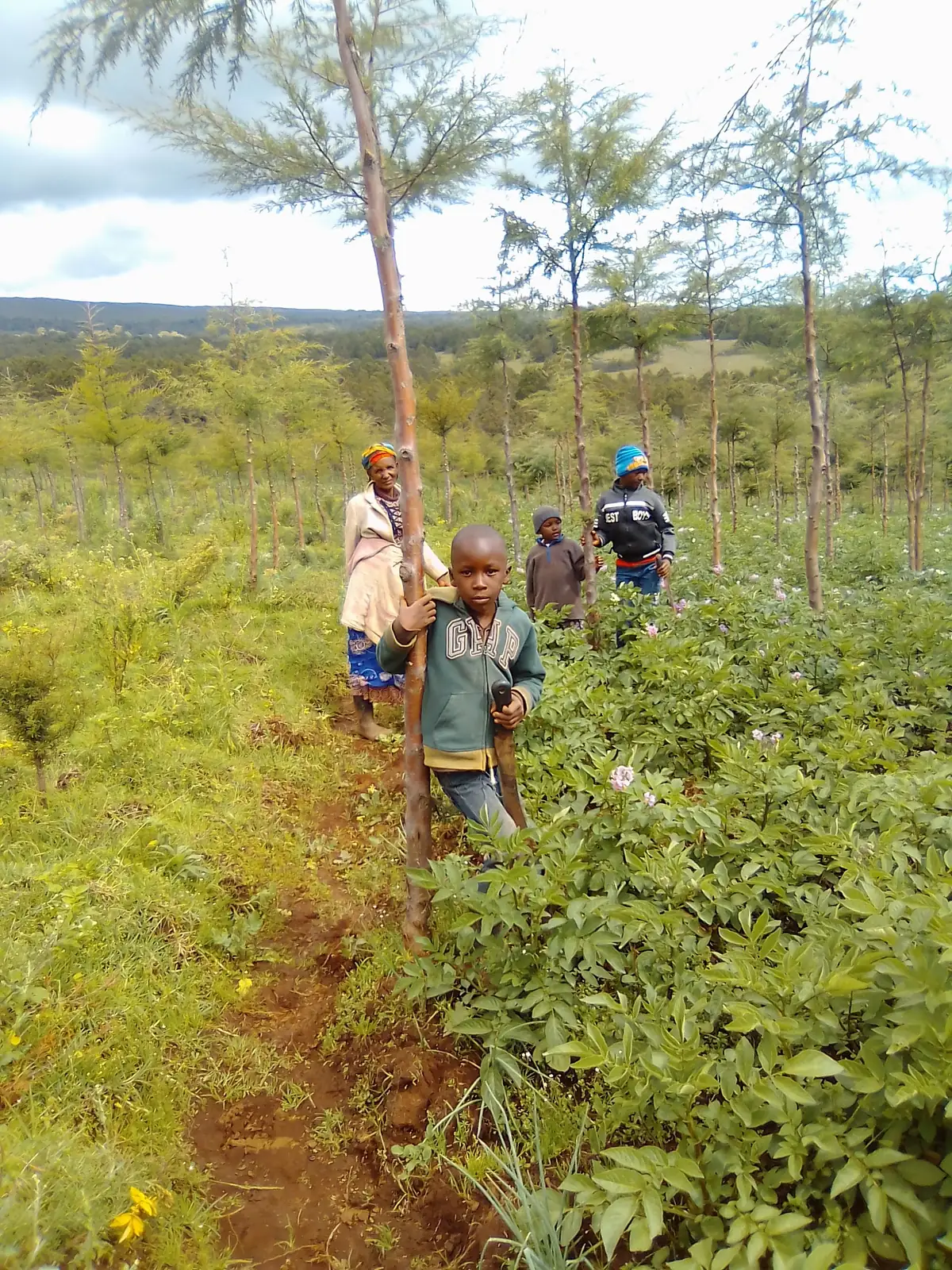
Agroforestry is one of the most common ways that smallholder farmers in Kenya could earn carbon credits. Trees are planted among maize, beans, tea or coffee, on plots that are often less than a hectare. The carbon they store is real, but it is hard to measure. A forest block can be surveyed as one unit. A farm with a few hundred trees scattered across many owners has to be counted differently, and the method used determines how many credits a project can issue.
Why Measurement Is Harder on Small Farms
A plantation or a protected forest offers a clear boundary and a fairly uniform canopy. Smallholder agroforestry does not. Trees may stand at the edge of a field, along a boundary, beside a homestead or in a row between crops. Ownership is divided among many households, and planting happens at different times. Project developers therefore have to gather information from many farms and combine it into one count that an independent verifier can check.
Baselines and Additionality
Before any tree is counted, a project needs a baseline: an estimate of what the land would have looked like without the project. For agroforestry this might be a field with few trees, a fallow that was regularly cleared, or a farm where fuelwood was cut and not replaced. The gain from planting is measured against that starting point. If farmers would have planted the same trees anyway, the project adds no carbon and the credits should not be issued. Verifiers look for evidence of this, such as past planting records, household surveys or local tree-cutting patterns.
How Tree Carbon Is Estimated
Trees are rarely weighed. Instead, field teams measure a simple, repeatable variable, usually diameter at breast height, and tree height where needed. They then apply an allometric equation, a formula that links those measurements to biomass. Most equations also need a wood density value for the species. Because the equation is only as good as the data behind it, the method should name the equation, its source and the species it covers. Applying a generic equation to a species it was never tested on is a common source of error.
Biomass is converted to carbon using a carbon fraction, and carbon is converted to CO2 equivalent by multiplying by 44/12. Below-ground root carbon is usually estimated with a root-to-shoot ratio. Each step should be stated in the project documents, so that a reader can follow the calculation from a tree's measurements to the final tonnes.
Plots, Sampling and Remote Sensing
Measuring every tree on every farm is rarely practical. Projects usually sample: they set up field plots, measure the trees inside them and scale the results up to the whole project area. The number of plots and how they are placed should follow the sampling rules in the methodology. Satellite imagery helps track canopy cover over time and shows where planting has happened, but it cannot reliably identify species or measure a single tree. Most projects combine the two, using remote sensing to locate and monitor the land and field plots to calibrate the numbers.
Buffers, Survival and Reversal
Trees die, are cut, or are lost to fire, drought and disease. A credible project accounts for this in two ways. Survival is checked in monitoring rounds, and dead trees are replaced or removed from the count. Many standards also require a buffer pool, a share of credits held back against reversal. Buyers should ask how the buffer is sized, how it is managed and what happens when a tree is lost after credits have been issued.
What Buyers Should Ask For
- The allometric equations and wood density values used, with their sources.
- The plot design, the sampling intensity and the date of the last field survey.
- The baseline assumptions and the evidence that the planting is additional.
- The survival rate found at the most recent monitoring round, and how dead trees are treated.
- Whether farm-level data is kept in a registry-linked system and who can audit it.
Our due diligence checklist covers the registry and contract checks that sit alongside these technical questions. For smallholder projects, the monitoring records matter as much as the headline tonnage.
Frequently Asked Questions
Is agroforestry the same as reforestation? Not quite. Agroforestry adds trees to working farmland, usually alongside crops or livestock. Reforestation restores forest cover on land that has been cleared, and the carbon accounting can differ.
Do the trees have to be native? Not always. Methodologies vary on this point, and many agroforestry projects plant fruit, timber and fodder species. The project documents should say which species are counted and why.
Who receives the credit income on a smallholder farm? That depends on the agreement between the farmer, the project developer and any aggregator. Benefit-sharing terms should be written down before planting begins.